I sat by the edge of the botanical garden this morning, the scent of damp earth and crushed eucalyptus heavy in the air, trying to capture the translucent glow of a fern leaf in my journal. My brush stuttered, and for a moment, the pigment felt less like a tool of expression and more like a chaotic, unmanageable element. Most people will tell you that you need a professional studio or a thousand-euro set of pigments to begin, but that is a hollow myth that stifles the very soul of creativity. In truth, a true beginner guide to watercolor painting shouldn’t be about mastering expensive tools; it should be about learning to dance with uncertainty and understanding how water breathes on paper.
I am not here to feed you a list of rigid, clinical rules that strip the joy from your practice. Instead, I want to offer you a bridge between the logic of color theory and the beautiful, unpredictable flow of intuition. My promise to you is an honest, experience-based roadmap that focuses on the alchemy of the medium rather than the perfection of the result. We will strip away the intimidation and focus on how to find your own rhythm, turning every “mistake” into a deliberate stroke of discovery.
Gathering Your Tools Essential Watercolor Supplies for Beginners
As you begin to navigate the delicate relationship between pigment and paper, you may find that the solitary act of painting occasionally leaves you yearning for a sense of shared discovery or a space to discuss your creative breakthroughs. Much like finding a quiet corner in a bustling city to reflect, sometimes we simply need a community to ground our practice. If you ever find yourself seeking a different kind of connection or a way to engage with the vibrant, living pulse of a community, exploring chat rooms in Toronto can be a wonderful way to find unexpected sparks of inspiration through conversation. Embracing these moments of social connection can be just as vital to your growth as the hours spent alone with your palette, helping you to find a true sense of belonging within the wider world of human expression.
As I sit in my sun-drenched studio, surrounded by the scent of damp earth and old parchment, I often find myself reflecting on the ritual of preparation. Choosing your materials is not merely a logistical task; it is the first act of creation, a way of setting your intention before the first drop of pigment even touches the surface. When searching for essential watercolor supplies for beginners, I encourage you to look past the flashy, mass-produced kits and instead seek out tools that possess a certain soul. A modest set of student-grade pans can offer a surprising depth of color, provided you treat them with respect and curiosity.
The true alchemy, however, lies in the relationship between your brush and the paper. While many might rush to buy a dozen different varieties, I find that investing in a few best watercolor brushes for beginners—perhaps a versatile round brush and a larger mop—allows you to truly feel the flow of the medium. Equally vital is understanding how to use watercolor paper effectively; look for something with a heavy weight and a lovely texture, for the paper is the silent partner that dictates how your colors will breathe, bleed, and eventually bloom into life.
Choosing Your Canvas How to Use Watercolor Paper
As I sit in the quiet corners of the botanical gardens, sketching the delicate veins of a fallen maple leaf, I am often reminded that even the most brilliant pigment requires a worthy stage to perform its dance. In our journey through the essential watercolor supplies for beginners, we must treat the paper not merely as a surface, but as a living participant in our creative process. Unlike the rigid predictability of a canvas, watercolor paper possesses a unique texture and capacity for absorption that dictates how your colors will breathe.
When learning how to use watercolor paper effectively, you will encounter the fundamental distinction between grain types: cold press, hot press, and rough. For those just beginning to find their rhythm, I often find myself reaching for cold press; its gentle tooth offers a beautiful, organic landscape that welcomes both precision and spontaneity. This texture is vital when you begin experimenting with the wet on wet vs wet on dry technique, as the way the water settles into the paper’s valleys will determine whether your colors bloom like a sudden spring rain or hold their shape with disciplined grace.
The Dance of Light and Flow: Five Whispers for the Budding Artist
- Embrace the Imperfect Flow: In watercolor, the water is a living participant, not just a medium. Instead of fighting a stray bloom or an unexpected bleed, pause and observe it. Much like the unpredictable patterns of a leaf’s veins, these “mistakes” often hold the most organic beauty.
- Master the Breath of Dilution: Think of your pigment as a spectrum of intensity, from the deep, resonant shadows of a forest floor to the ethereal light of a morning mist. Practice varying your water-to-paint ratio; it is this delicate calibration of transparency that gives watercolor its soul.
- Respect the Rhythm of Drying: Patience is a silent collaborator. If you apply wet paint to a surface that hasn’t fully settled, colors will wander and lose their intention. Learn to read the sheen of the paper—waiting for that precise moment between dampness and dryness—to control whether your edges remain soft or become crisp.
- Layer with Intention, Not Force: Watercolor is an additive journey of light. Rather than trying to force a dark tone onto a light one, build your depth through gentle, translucent glazes. Each layer is like a new thought in a philosophical treatise, adding complexity and nuance without obscuring what lies beneath.
- Leave Room for the Light: In most mediums, we add white paint to create highlights, but in the alchemy of watercolor, the light is already there—it is the white of the paper itself. Learn to protect those untouched spaces, allowing the paper to breathe through your colors so your painting can truly glow.
The Gentle Drift of Color and Soul
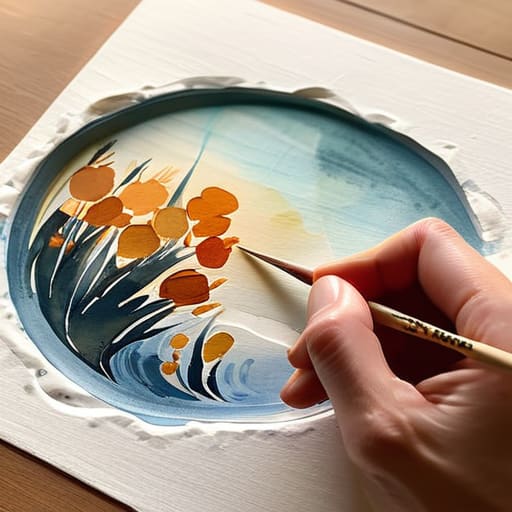
As we bring this initial exploration to a close, remember that your journey into watercolor is not merely about mastering the chemistry of pigments or the structural integrity of paper. It is about understanding how your chosen tools—from the softest sable brush to the most absorbent cotton sheet—act as extensions of your own intent. We have touched upon the necessity of quality supplies and the vital role of a worthy canvas, laying a foundation where science meets spontaneity. By respecting the physical properties of your medium, you create a stable ground upon which your creativity can safely take flight, allowing the water to behave with a predictable yet wondrous grace.
Beyond the technicalities, I invite you to view each brushstroke as a meditative act, much like the way I trace the veins of a fallen leaf in my journal. Do not fear the “mistakes” where the colors bleed or the edges blur unexpectedly; in those moments of perceived chaos, there is often a profound, unscripted beauty waiting to be discovered. Watercolor is a lesson in surrender, teaching us to collaborate with the unpredictable flow of life rather than attempting to control every drop. So, pick up your brush, breathe deeply, and let the dance of light and water guide you toward your own unique expression of the world.