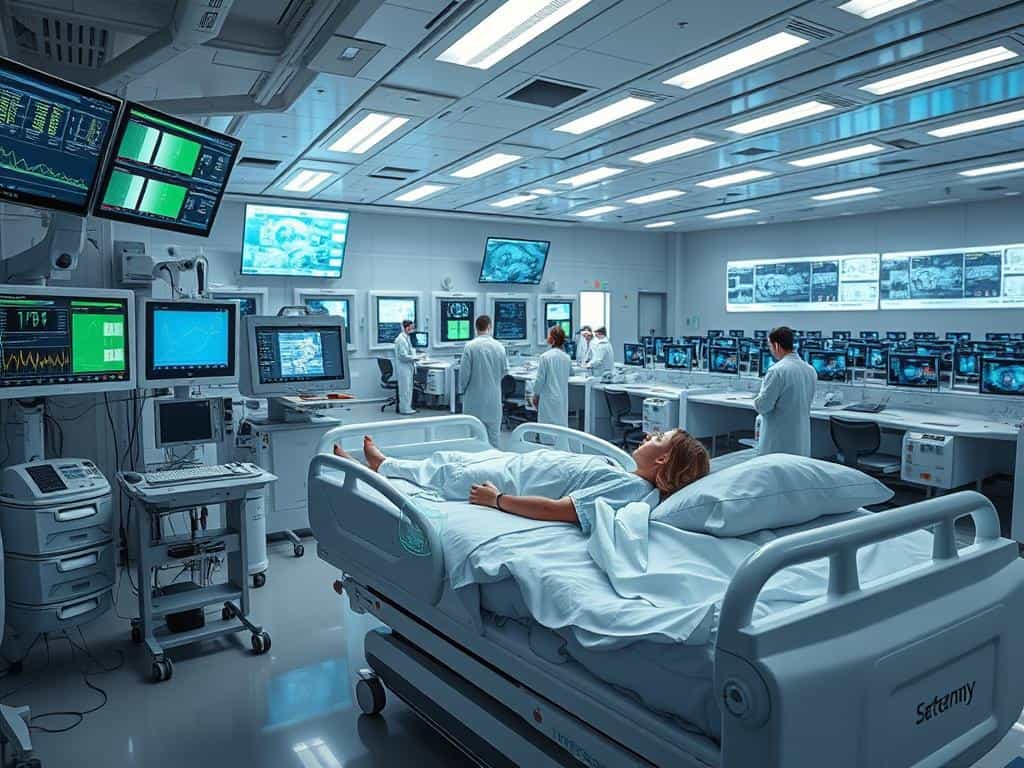
Did you know that by 2030, the world will face a huge shortage of 18 million healthcare workers? This includes 5 million fewer doctors than needed. This crisis shows how urgent it is for smart healthcare solutions that use automation in medicine.
Healthcare systems worldwide are dealing with high costs, aging populations, and not enough workers. Technology leaders like Microsoft, Apple, and Google see AI in healthcare as a game-changer. They believe it will lead to new medical practices that make patient care better.
Technology integration can make diagnostics faster and care delivery better. By using automation, we can handle paperwork better. This lets healthcare providers spend more time with patients.
As we move forward, the power of healthcare tech to help stressed systems gives us hope. It shows a brighter future for medicine.
Key Takeaways
- The healthcare industry faces a projected shortage of 18 million professionals by 2030.
- AI and automation can significantly reduce administrative burdens and improve operational efficiency.
- Technology leaders are advocating for the integration of AI to enhance patient care and diagnostics.
- Smart healthcare solutions promote a shift towards preventative, data-driven disease management.
- Automation is a critical component for addressing healthcare costs and improving service delivery.
Introduction to Automation in Healthcare
Automation in healthcare is becoming more popular as companies try to solve healthcare challenges. The global healthcare automation market was worth USD 35.2 billion in 2022. It’s expected to grow to USD 90.88 billion by 2032, showing a huge increase of over 150% in ten years. This shows how important technology integration is for better patient care and work efficiency.
The Rise of Automation in Medicine
The COVID-19 pandemic has made automation in healthcare even more urgent. It showed the need for modern healthcare systems, highlighting staff shortages and unequal access to care. About 92% of doctors think technology can make patient care better, showing how AI in healthcare is helping with faster patient checks and better treatment plans.
Challenges Facing Healthcare Systems
There are big challenges, though. Bad data systems cause problems in 60% of cases, making it hard to find high-risk patients in 59% of cases. Doctors spend four hours a day on paperwork, with 44% of that time on electronic health records for admin tasks. This waste of time leads to burnout, with 92% of healthcare workers blaming too much paperwork.
The Promise of Technology Integration
Automation in healthcare can make things better and cheaper while keeping patient care top-notch. Almost 99% of US hospitals use barcode systems and electronic records for safer medication. Leaders see automation as a way to improve care delivery across the board.
Smart Healthcare: Key Features of Automation
Automation has changed healthcare, making it better for patients and staff. It brings new tools like AI diagnostics and robotic surgery. These changes make healthcare more efficient and patient care better.
Artificial Intelligence in Diagnostics
AI diagnostics have changed how doctors read patient data. They use smart algorithms to quickly find what’s wrong. This means patients get the right treatment faster.
Robotic Surgery and Enhanced Patient Care
Robotic surgery is a big step forward in patient care. It lets surgeons do operations with more precision and less harm. This means patients recover faster and have less pain.
Streamlining Administrative Processes
Automation helps with the paperwork side of healthcare too. It makes tasks like checking insurance and handling claims easier. This means doctors can focus more on patients, making care better for everyone.
The Future of Smart Healthcare
Healthcare is changing fast, thanks to new technologies. These changes aim to make care better and more efficient. AI in precision medicine is a big part of this, making treatments fit each patient’s needs.
This approach leads to more accurate diagnoses and treatments. It means patients might see better health results.
Emerging Technologies Shaping Healthcare
Telemedicine is getting a lot of attention, with over 2000 studies worldwide. It’s shown to cut down on hospital visits and make care faster. This model is making healthcare more accessible, reaching people in clinics and at home.
AI and robotics are also making healthcare more efficient. They’re taking over routine tasks, freeing up doctors to focus on more important work.
The Role of AI in Precision Medicine
AI is already making a big impact in healthcare. For example, AI algorithms are better at finding cancer in images than doctors. This shows AI in precision medicine is real and happening now.
As we keep innovating, healthcare will move towards a more patient-focused model. This will lead to better care and experiences for everyone.
Challenges and Opportunities Ahead
There are big challenges to overcome with new healthcare technologies. Issues like data privacy and the job impact of AI need to be solved. The WHO sees these challenges as key for the 21st century.
Finding a balance between new tech and ethics is key. Keeping up with new healthcare tech and making sure it’s used responsibly is essential.
Conclusion
Automation in medicine has changed healthcare a lot. It makes doctors more accurate and saves time on paperwork. This leads to better care and makes healthcare systems work better.
Health Care 4.0 brings together many medical devices and data analytics. This helps create care plans that work better for patients. It also makes treatments more effective.
From managing meds to treating diseases, we need better tools. These tools help doctors, patients, and caregivers work together better. Telehealth has become more popular, thanks to COVID-19. It makes patients happier and more satisfied.
But, we also need to think about the ethics and jobs in healthcare. Automation brings new challenges and chances. It’s important to handle these well.
Looking to the future, smart healthcare will keep getting better. IoT devices and electronic health records give us real-time data. This makes patients safer and reduces mistakes.
I’m hopeful about the future of healthcare. Smart technologies will make healthcare better. They will make it more effective, satisfying, and improve health outcomes for everyone.
