Did you know the International Space Station (ISS) has led to over 20 breakthroughs in the last 20 years? This space lab has changed how we see science and technology today. It has helped us learn how to recycle water in space and understand the universe’s secrets.
Exploring these breakthroughs shows how they’ve changed our view of the world. They’ve helped us understand diseases, space, and life’s basics. These discoveries show the power of science and working together.
In this article, we’ll look at the top five scientific discoveries of the 21st century. We’ll see how they’ve changed our world.
Key Takeaways
- The ISS has supported over 20 significant breakthroughs in its two decades of operation.
- Advanced filtration systems allow astronauts to recycle 93% of their water while in space.
- The detection of gravitational waves confirmed key parts of Einstein’s theory.
- Major advancements in understanding diseases have resulted from research conducted aboard the ISS.
- Discoveries regarding cosmic particles provide insight into the universe’s makeup.
Detection of Gravitational Waves
The discovery of gravitational waves has changed how we see the universe. It proved parts of Einstein’s theory of relativity right. The LIGO project found these waves on September 14, 2015.
They came from two black holes merging. These black holes were 29 and 36 times more massive than our sun. This happened 1.3 billion years ago.
The LIGO detectors, 7 milliseconds apart, picked up these waves. They can spot changes as small as one-ten-thousandth the size of a proton. This shows how far we’ve come in finding gravitational waves.
When the black holes merged, they turned about 3 suns’ worth of mass into energy. The power of these waves was more than 50 times the whole visible universe’s. This confirms Einstein’s ideas and opens new doors for space research.
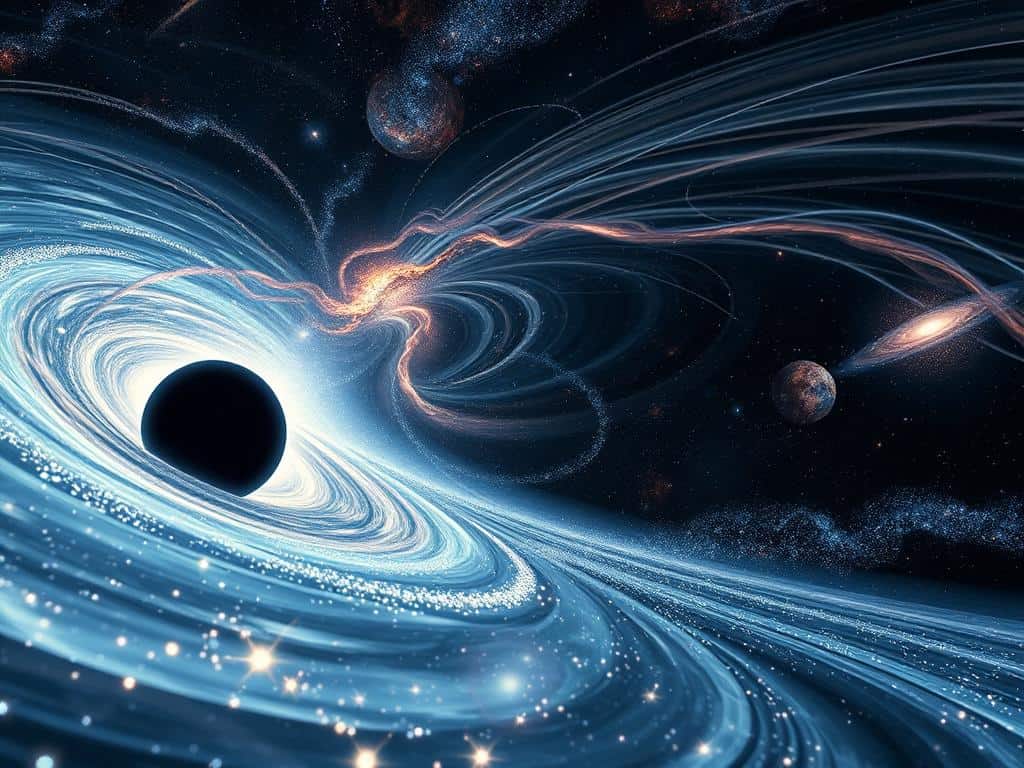
With LIGO and projects like Virgo, scientists are getting better at finding these waves. They’re building new detectors, including one in India. This will help us see more cosmic events. As they study these waves, they’re uncovering the universe’s secrets, just like Einstein did.
Scientific Discoveries that Changed Our View on Mars
Missions to Mars have made huge Mars discoveries that changed how we see the planet. One key finding is the presence of liquid water on Mars. NASA’s Mars Reconnaissance Orbiter was key in this discovery. It used advanced imaging to find hydrated salts, showing that water might exist seasonally, possibly supporting life.
The Role of Liquid Water on Mars
The Opportunity rover found small, round deposits of hematite, called “blueberries,” showing water once flowed on Mars. The Spirit rover found rocks full of magnesium and iron carbonates, helping us understand Mars’ minerals. Discoveries of 90% pure silica at “Home Plate” suggest ancient hot springs or steam vents, supporting theories about liquid water.
Future Mars Missions
Looking ahead, future exploration missions will build on these discoveries. NASA’s ExoMars rover, named Rosalind Franklin, will launch in 2028 and dig up to two meters into Mars. The Earth Return Orbiter (ERO) will be the first to bring Mars samples back to Earth, a big step in our space missions. Each NASA mission brings us closer to understanding Mars and its life-supporting possibilities, leading to human colonization.
Conclusion
Looking back at the 21st century, we see huge leaps in science. From finding gravitational waves to discovering water on Mars, each find is a big step forward. These discoveries change how we see the world and our place in it.
Science shows us how connected we are to nature. It tells us about the big changes happening because of us. This makes it clear we need to act fast to protect our planet.
The future of science looks bright. With more research and a love for learning, we’ll find even more amazing things. These discoveries help us understand the world and prepare for what’s next.
