
Did you know that about 27% of the universe is dark matter? This stuff we can’t see is a big deal. It’s heavier than the stuff we can see by a lot, 6:1. Dark matter is key to how the universe is structured.
While we can see only 5% of the universe, dark matter makes up about 85%. It’s a big part of physics and astronomy. It helps shape galaxies and how the universe grows.
Dark matter is mysterious because we can’t see it. It doesn’t reflect light like regular matter does. Scientists from places like the Department of Energy and NASA are working hard to learn more. Let’s explore what dark matter is and its role in our universe.
Key Takeaways
- Dark matter constitutes approximately 27% of the universe.
- Visible matter accounts for only about 5% of the universe’s content.
- The effects of dark matter significantly influence galaxy formation.
- Researchers utilize various methods to search for dark matter particles.
- The gravitational effects of dark matter exceed those of visible matter by about five times.
Understanding the Basics of Dark Matter
The universe is vast and full of mysteries. Exploring Dark Matter is fascinating because it’s different from the Matter we see every day. Knowing how they differ helps us understand the universe better.
What is Matter and How is Dark Matter Different?
Matter is anything with mass and takes up space. It includes the air we breathe and the planets we orbit. Dark Matter, on the other hand, is mysterious. It doesn’t interact with light, making it invisible.
Research shows Dark Matter makes up about 27% of the universe. It’s about 85% of all Matter. In galaxies, Dark Matter is five times more common than regular Matter.
The Role of Dark Matter in the Universe
Dark Matter is vital for the universe’s structure and dynamics. Its gravity helps hold galaxies together. Without it, galaxies would fall apart.
Studies suggest Dark Matter is concentrated at galaxy centers. It acts like invisible glue, keeping galaxies bound. This helps explain why stars at galaxy edges move so fast.
The Observational Evidence of Dark Matter
Dark Matter is a mystery that astronomers have been trying to solve for a long time. They have found clues that show it’s not just about what we can see. These clues help us understand how the universe works.
Key Discoveries by Early Astronomers
Scientists like Fritz Zwicky and Vera Rubin were key in finding Dark Matter. Zwicky found that galaxies in the Coma cluster moved really fast. This suggested there was a lot of unseen mass holding them together.
Vera Rubin showed that stars in galaxies moved faster than expected. This was because there was more mass than we could see. These discoveries changed how we think about galaxies and the universe.
How Dark Matter Influences Galactic Formation
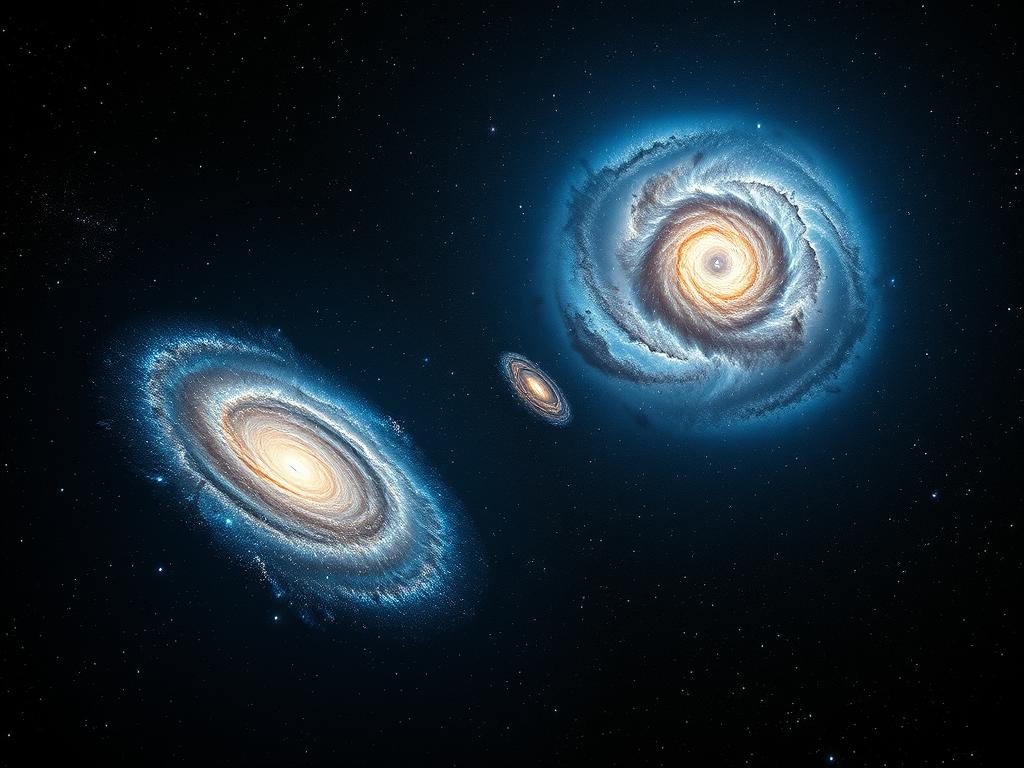
Dark Matter is vital for galaxies to form and stay stable. It gives the gravity needed for stars to stick together. Without it, stars wouldn’t stay in galaxies.
My research shows that Dark Matter affects how galaxies grow. Dwarf galaxies have more Dark Matter than big ones. This helps us understand how galaxies are shaped.
Conclusion
Dark Matter is a huge mystery in our universe. It makes up about 63% of all matter. Yet, we can’t see it with our usual ways of looking.
We know it’s there because of how it pulls on other things. For example, the Bullet Cluster shows its effects. Early scientists like Fritz Zwicky also found clues.
Learning about Dark Matter helps us understand the universe better. It’s about 80% of what’s in galaxies. This means there’s a lot more Dark Matter than we can see.
This discovery opens up new ideas about hidden structures and particles. Places like the Large Hadron Collider are working hard to find out more.
Exploring Dark Matter makes me think about all the things we don’t know. It’s exciting to imagine what’s out there. With Dark Matter making up 85% of the universe, every new finding changes how we see things.
