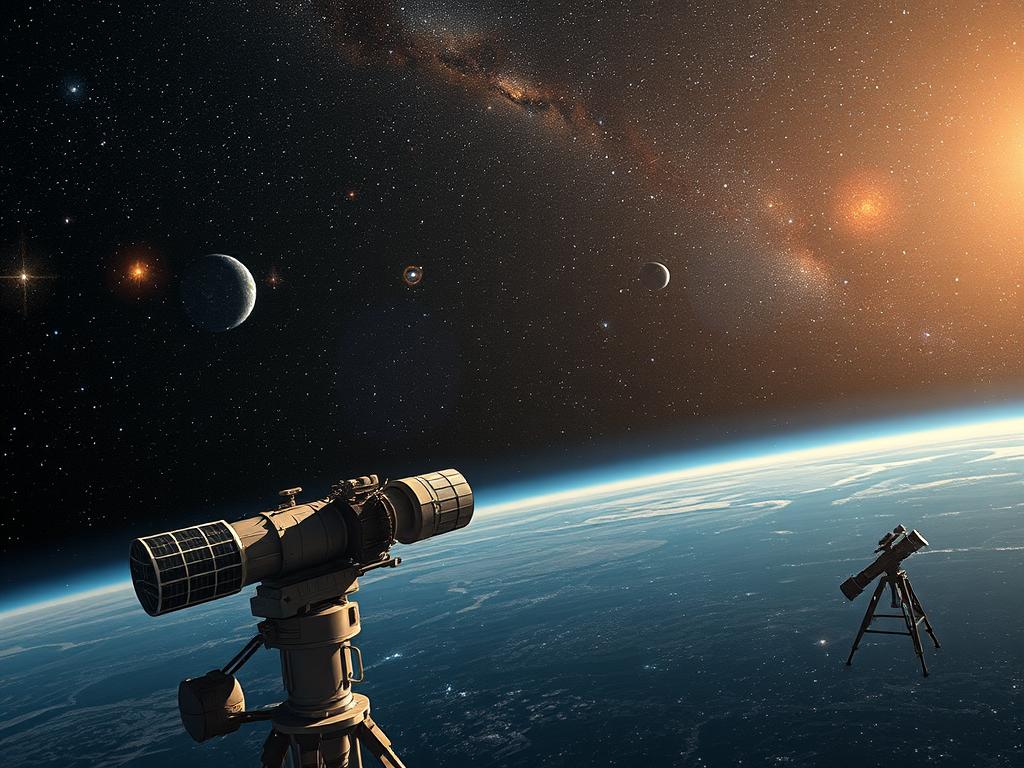
Did you know that over 4,000 exoplanets have been confirmed with the Hubble Space Telescope’s help? This shows the huge impact space telescopes have on astronomy. For over 30 years, Hubble has given us amazing views of the universe. It has shown us things we couldn’t see from Earth.
Hubble has made more than 1.5 million observations. It has helped us learn about far-off galaxies and our own Solar System. In this article, we’ll look at how space telescopes like Hubble change our view of the universe.
Key Takeaways
- Space telescopes have provided clear views of the universe, free from Earth’s atmospheric distortions.
- Hubble has conducted over 1.5 million observations, greatly helping modern astronomy.
- Over 4,000 exoplanets have been confirmed with the help of space telescopes, including Hubble.
- Hubble’s transformative images continue to deepen our understanding of cosmic phenomena.
- Space telescopes like Hubble are key in mapping our Solar System and exploring the dark universe.
The Role of Space Telescopes in Modern Astronomy
Space telescopes have changed how we see the universe. They let us look at the cosmos in ways we couldn’t before. This is thanks to the dreams of early astronomers who wanted to see the stars without Earth’s atmosphere getting in the way.
Origins of Space Telescopes
Big ideas in the early 1900s started the journey to space telescopes. Scientists wanted to overcome the limits of looking at the sky from the ground. After years of work, the Hubble Space Telescope was launched in 1990. It changed how we study the universe, showing us distant galaxies and cosmic events.
The Hubble Space Telescope: A Transformative Tool
Hubble has given us amazing pictures and important data. It can spot objects as small as 0.05 arcseconds apart. This is like finding two fireflies in Tokyo from Washington, D.C.
Hubble can see light from objects much fainter than we can from Earth. It looks at the universe in wavelengths from ultraviolet to near-infrared. This lets astronomers study things like NGC 3147, a galaxy 130 million light-years away.
Over 30 years, Hubble has given us a clear view of the universe. It operates above the atmosphere, giving us insights into the cosmos.
How Space Telescopes Revolutionize Our Understanding
Space telescopes have changed how we see the universe. They help us find exoplanets and explore the dark universe. These discoveries let us know more about distant worlds and the universe itself.
Discoveries of Exoplanets
Exoplanets, or planets around other stars, are a big part of space research. The Hubble Space Telescope has been key in finding these planets. It has helped us learn about thousands of them.
By studying exoplanet atmospheres, Hubble has found important things like water vapor. This helps us figure out if a planet can support life.
Illuminating the Dark Universe
Space telescopes also help us understand the dark universe. They let us study dark matter and dark energy, forces that make the universe expand. Hubble’s work has given us new insights into these mysteries.
With new tools like the James Webb Space Telescope, we can learn even more. We can map galaxies and see how they change over time. This helps us understand the universe’s complex nature.
Key Contributions of Hubble and Other Space Telescopes
The Hubble Space Telescope, along with other space observatories, has greatly expanded our knowledge of the universe. Its special abilities allow for detailed observations. These have changed many areas in astronomy.
Monitoring Our Solar System
Hubble’s role in monitoring our solar system is huge. It tracks weather on planets like Jupiter and studies the movements of distant bodies. Its high-quality images show storms, auroras, and even the breaking apart of asteroids.
These efforts greatly improve our understanding of our solar system.
Creating Cosmic Portraits
Hubble has made stunning cosmic images that amaze scientists and the public. One famous image is the Pillars of Creation in the Eagle Nebula, showing star formation. These pictures show the detailed structures and processes in galaxies.
They let us see the universe in ways we never thought possible.
Beginning of Cosmological Studies
Hubble’s work over three decades has laid the groundwork for cosmological studies. Its discoveries have changed how we see galaxy formation and star lifecycles. With over 1.6 million observations, Hubble has given us key data for understanding the universe’s history.
Conclusion
Reflecting on the space telescopes impact, it’s clear they’ve changed how we see the universe. The Hubble Space Telescope has shown us new worlds and set the stage for the future of astronomy. Launched in 1990, Hubble has made 1.5 million observations. It has found over 1,400 exoplanets and helped us understand dark energy, which makes up 70% of our universe.
The James Webb Space Telescope brings new technology to the table. Its huge mirror and infrared vision will let us see through cosmic dust. This will help us learn more about stars and galaxies. These ongoing discoveries show us how much we have yet to learn. With missions like LUVOIR and Origins Space Telescope coming, the excitement for new findings is growing.
The exploration journey of space telescopes is far from over. I’m looking forward to the new insights these observatories will bring. They will deepen our understanding of the universe and challenge our views. The future of astronomy looks bright as we continue to explore the unknown.
