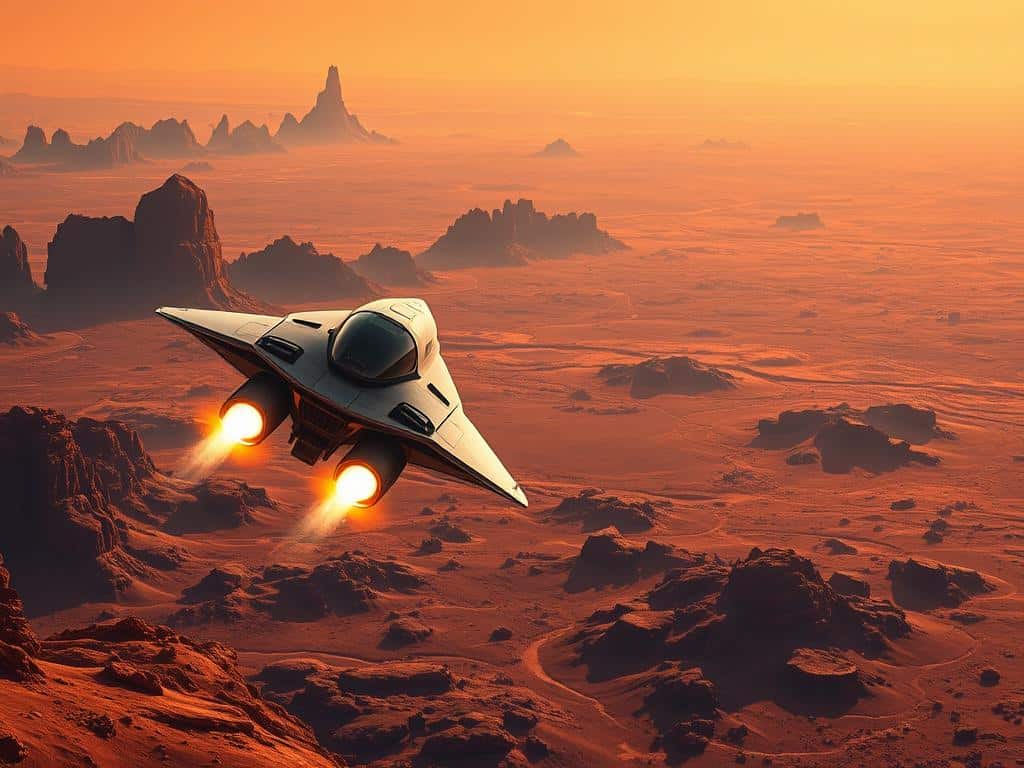
Did you know a trip to Mars would cover over 1 billion miles? That’s more than 1,000 times what NASA’s Artemis I mission did. This shows how big our goal to reach Mars and beyond really is.
Mars is now a key target in space exploration. Knowing why we want to go there and the challenges we face is key. Mars is between 33 million and 249 million miles from Earth. A trip there could take about 500 days.
The conditions on Mars are harsh. Temperatures can drop to -284 degrees Fahrenheit. The gravity is only one-third of Earth’s. NASA and companies like SpaceX are working hard to send humans to Mars. This could change how we see life beyond Earth and inspire more missions.
Key Takeaways
- The distance from Earth to Mars varies from 33 million to 249 million miles.
- A complete mission to Mars could last between 2 to 3 years.
- NASA and SpaceX are at the forefront of plans for human missions to Mars.
- Mars has an atmosphere composed of 96% carbon dioxide, making living conditions challenging.
- Traveling to Mars requires innovative technologies due to its extreme temperatures and distance.
Current Technologies Advancing Space Travel to Mars
The journey to Mars is filled with exciting tech advancements by NASA and SpaceX. These groups are working hard to make human trips to Mars possible. It’s important to know what they’re creating to understand how we’ll get to Mars.
NASA’s Innovations for Mars Missions
NASA is leading the way in Mars mission tech, aiming for astronaut trips by the 2030s. The Mars Oxygen In-Situ Resource Utilization Experiment (MOXIE) is a key project. It turns Martian air into oxygen, essential for long stays.
NASA is also working on life support systems that recycle air, food, and water. They’re testing a big inflatable heat shield for safer landings. This shield could make Martian landings much safer.
SpaceX and the Interplanetary Transport System
SpaceX is making big strides in space travel with the Interplanetary Transport System (ITS). It uses 42 Raptor engines to carry up to 300 tons of cargo. This is key for Mars missions to succeed.
Powering Mars Missions
Power is vital for Mars missions, as dust storms can block sunlight. NASA is looking into nuclear fission for steady power. This is important for Mars’ long-term operations.
Technologies like nuclear thermal propulsion (NTP) could cut travel times. This makes the 140 million-mile trip to Mars more feasible.
Challenges of Space Travel to Mars
Going to Mars is a big challenge. The distance and time it takes to get there are huge hurdles. Thinking about it, the difficulties of Mars travel become clear.
Distance and Duration of Travel
The trip to Mars is over 140 million miles on average. It takes about nine months to get there. A round trip could take two to three years.
Astronauts will face long periods without help. They’ll live in small spaces for years. This makes getting enough food and supplies very important.
Human Factors to Consider
The people going on these missions are key. Living in space for a long time can hurt their mental health. They need to work well together and solve problems.
Studies show isolation can make people tired and stressed. This affects their mood and health. The delay in communication makes things even harder. It can make people feel alone and affect their work.
Conclusion
Looking at the future of space travel and Mars exploration, we’re on the brink of big changes. The path to sending humans to Mars is filled with challenges. These include solving technological problems and thinking about social issues.
NASA and SpaceX have bold plans, but landing humans on Mars might take until the 2030s. This depends on how fast technology improves and if we get enough money.
The U.S. has been a leader in space science for 25 years. But, as more countries explore space, this role is changing. Our achievements in Apollo and the Space Shuttle set a high bar.
Now, we face new challenges that need a fresh approach to education. We must prepare the next generation of scientists and engineers. Space biology and medicine are key areas to focus on, helping us succeed on Mars.
In summary, reaching Mars is within our grasp, but it’s not easy. The journey requires hard work and dedication. The future of space travel depends on our ability to inspire and prepare young minds.
Insights from space missions will be key to making our dreams of Mars a reality. They will guide us towards achieving our goals in space.
