
Did you know over 60 percent of manufacturing leaders are working with tech companies to boost their smart factory plans? This shows a big change towards smart factories. Here, IoT and automation are changing how things are made.
These places are leading the fourth industrial revolution, called Industry 4.0. It combines digital tech with old-school making things.
Smart factories use IoT to make things better, cut down on stops, and solve big problems. They can use big data to find new ways to make money and stay ahead. AI and robots help make things faster and better, even when there aren’t enough skilled workers or when supply chains get messed up.
In the next parts, we’ll look at how smart factories have changed and how IoT and automation are changing making things today.
Key Takeaways
- Smart factories are vital in the transition towards Industry 4.0.
- IoT technology minimizes downtime and optimizes manufacturing processes.
- Big data facilitates enhanced production efficiency and waste reduction.
- Collaboration with tech companies is key for advancing manufacturing initiatives.
- Smart factories benefit various industries, including automotive and electronics.
- Businesses are prompted to adopt a ‘think big, start small, and scale fast’ approach in smart manufacturing.
The Evolution of Smart Factories
The path to modern smart factories began with the Fourth Industrial Revolution, or Industry 4.0. This era brought digital technologies into manufacturing. It has greatly changed how we make things and compete in different markets.
Understanding the Fourth Industrial Revolution
The Fourth Industrial Revolution changed how factories work. It brought in IoT, big data, and AI. These tools help with automation and real-time data, making smart factories possible.
Coca-Cola is a great example of how companies can get better with these new technologies. They make production more efficient and flexible. This leads to better communication between devices and systems.
History and Impact of Industrial Revolutions
Looking back, each industrial revolution has changed the market. The first ones moved from farming to factories, introducing machines and assembly lines. Henry Ford was a big name in this change.
The Third Industrial Revolution brought in digital tech, making production more automated. Today, we see smart factories that are more efficient and waste less.
Key Features of Modern Smart Factories
Today’s smart factories have key features. They use real-time data to make better decisions. This helps them quickly adapt to market changes.
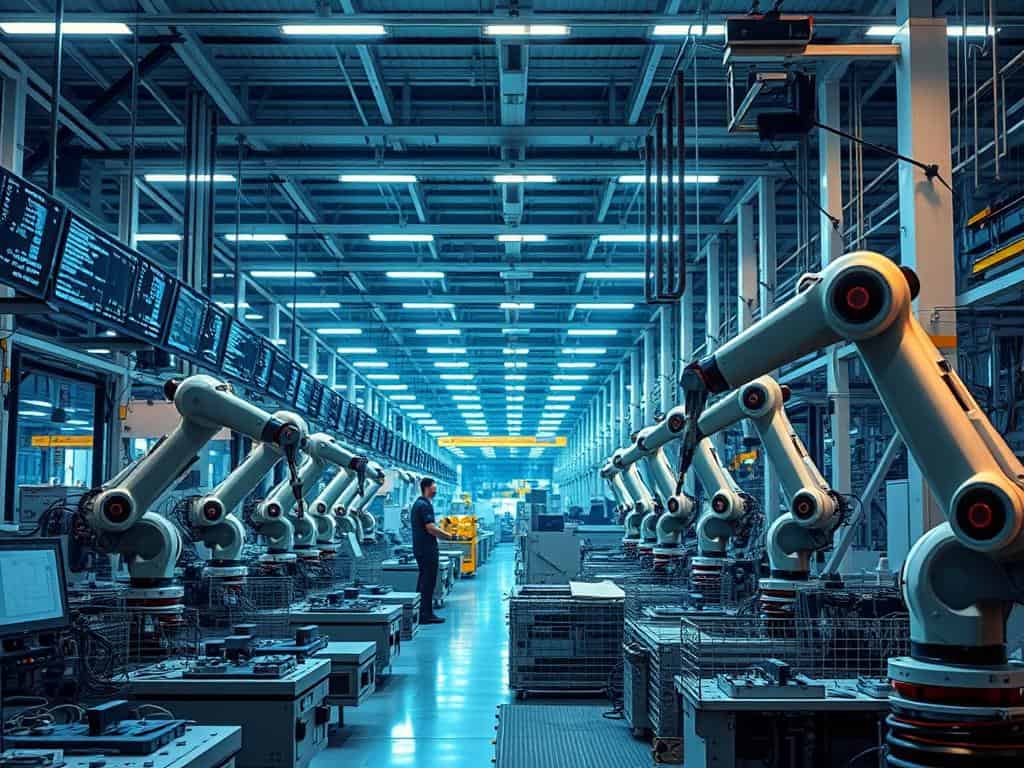
Automation is also key, making production more efficient. Robots work all the time, meeting supply chain demands. These factories are flexible, allowing for customization and on-demand production.
This approach boosts productivity and supports sustainability. It reduces waste and optimizes resource use.
Smart Factories: The Role of IoT and Automation
In today’s manufacturing world, using real-time data is key. IoT sensors help me collect data on machine performance and supply chain logistics. This data lets me quickly spot and fix problems, making operations more efficient.
With better insights, I can find and fix issues fast. This boosts productivity and cuts costs. It’s a win-win for everyone involved.
Real-Time Data Utilization
Real-time data is vital in making manufacturing better. IoT technology gives us the tools to analyze and improve our processes. For example, tracking machine performance in real time helps us make smarter decisions.
Predictive Maintenance
Predictive maintenance is a big plus of IoT. It lets me monitor equipment health and predict when it might fail. This way, I can avoid costly breakdowns and save on maintenance.
Companies like Artesis have seen a 20% drop in maintenance costs and a 10% boost in production efficiency. It’s a smart move for any business.
Enhanced Supply Chain Management
IoT has changed how we manage supply chains. It lets me track inventory and shipments in real time. This helps me adapt to changes in demand and optimize delivery routes.
76% of supply chain leaders want digital solutions for better visibility. IoT helps make these solutions a reality. It improves decision-making and keeps customers happy.
Challenges and Solutions
Despite the benefits, there are hurdles to overcome. Data security is a big concern, as is getting different systems to work together. The cost of starting can also be a barrier.
To tackle these issues, I focus on strong cybersecurity and finding compatible tech. A gradual approach helps ensure a smooth transition. It’s all about finding the right balance for success.
Conclusion
Smart factories are changing the game in manufacturing, thanks to IoT and automation. I see industries using these new techs and it’s exciting. They’re getting better at making things, working faster, and making products that are top-notch.
These smart factories are making big changes in how we make things. They help companies keep up with what customers want and what the market needs. It’s a big shift in how we produce goods.
Platforms like Equans Digital show how important data is. They help make operations better and use less energy. AI and machine learning are also making big changes. They help predict things like cement yields and control steam flow.
These changes are not just small improvements. They’re changing how we think about making things. It’s a whole new way of doing business.
Smart factories also help the environment. They make industries and cities better places. They make workers more productive, too, with a 10-12% boost in some cases.
This shows how important it is for companies to use these new technologies. It’s not just a choice anymore. It’s a must for any business that wants to succeed in today’s world.
