
Did you know NOAA has 159 Doppler radar towers across the U.S.? This network gives us vital data for forecasting. It’s part of a big change in how we predict the weather. Now, our five-day forecasts are as good as one-day forecasts were in 1980.
This improvement comes from better technology and science. It shows how far we’ve come in understanding the weather.
In my research, I see how new tech and old science come together. We use things like radiosondes and supercomputers to predict the weather. It’s amazing to see how far we’ve come.
Key Takeaways
- NOAA’s Doppler radar towers provide essential coverage for weather data.
- Recent advancements enable more accurate five-day forecasts than past one-day predictions.
- Improved tools enhance our understanding of atmospheric dynamics.
- Supercomputers revolutionize weather data processing and forecasting accuracy.
- Weather forecasting tools have evolved significantly over the last few decades.
The Foundations of Weather Forecasting
Weather forecasting is complex, starting with atmospheric dynamics. Temperature, humidity, and wind patterns are key. Meteorologists use these to predict the weather.
Understanding Atmospheric Dynamics
Atmospheric dynamics studies air movements and pressure differences. Temperature affects everything from clouds to rain. Knowing air pressure helps understand wind patterns.
Key Elements Influencing Weather Patterns
Weather patterns are shaped by solar radiation and ocean currents. Forecasting has improved with Doppler radar and satellite data. Numerical weather prediction models also play a big role.
Meteorology’s Evolving Tools and Technologies
The world of meteorology is always changing with new tools and technologies. These advancements make collecting and processing data more efficient. This leads to better weather predictions.
Ground-based weather stations are key, giving real-time info on the atmosphere. They work with automated systems to give detailed data. This data makes forecasts more accurate.
Ground-Based Observations and Automated Systems
Weather stations on the ground track important weather details in real-time. Automated systems, like the Automated Surface Observing Systems (ASOS), collect data often. They help make weather analysis more precise.
These tools ensure many forecasts are close to the actual weather. About 90% of 1-day forecasts are within 2°C of what really happens.
Advanced Remote Sensing Technology
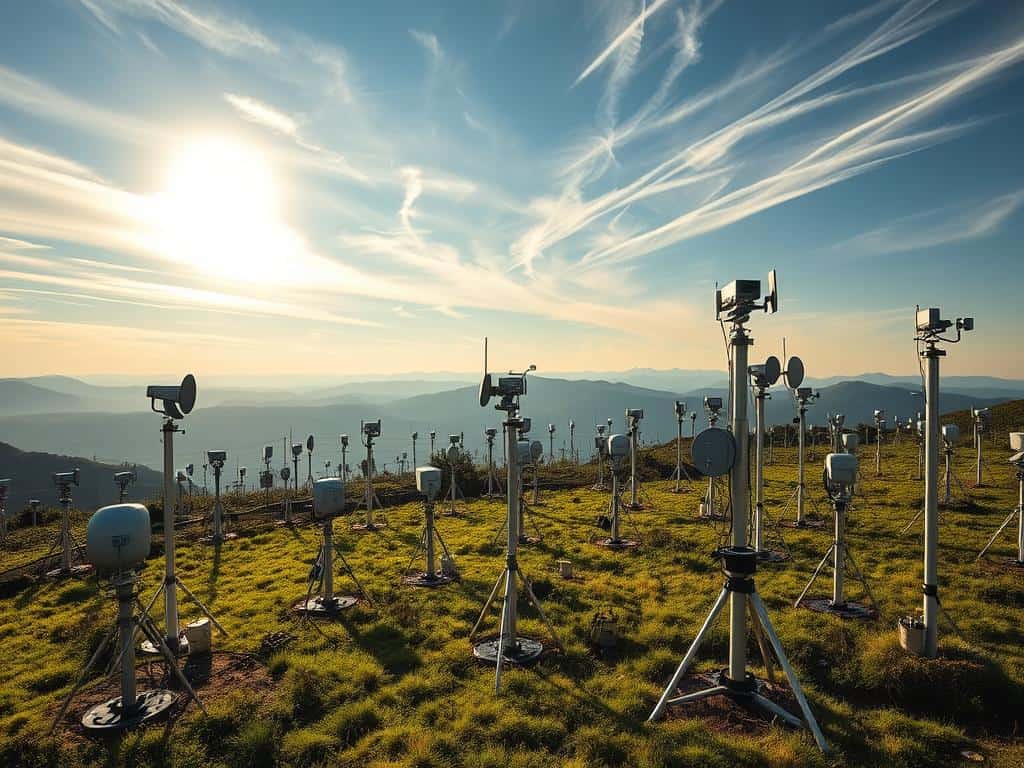
Ground-based tech is joined by advanced remote sensing tools like Doppler radar and satellite data. Doppler radar helps spot and study storms, like tornadoes, more accurately. Satellite data gives insights into global weather, showing cloud patterns and moisture.
This tech gives a full view of the atmosphere. It’s key for making reliable forecasts.
Mathematics and Modeling in Weather Prediction
Weather prediction is a complex field that combines mathematics and atmospheric science. It’s amazing how numerical weather prediction uses math to predict weather patterns more accurately. This method, started in the 1950s, uses supercomputers to do 8 quadrillion calculations every second. This has greatly improved our ability to predict the weather.
Numerical Weather Prediction (NWP)
NWP is based on complex equations from thermodynamics and fluid dynamics. It uses data assimilation to mix real-time observations with weather models. This helps meteorologists simulate the atmosphere more accurately.
Thanks to better computers, we can now model the atmosphere in more detail. This means weather models can solve complex equations across different layers of the atmosphere. This leads to detailed analyses that were once impossible.
Ensemble Forecasting
Ensemble forecasting is another important part of weather prediction. It involves running many model simulations to show different possible weather outcomes. This method creates a “cone of uncertainty” to help track storms, like hurricanes.
Even though the cone gets wider over time, new math techniques have made it more accurate. This has greatly improved our ability to predict the weather over long periods.
Conclusion
The science of meteorology is always changing, thanks to new discoveries that make our forecasts better. Even with these advances, predicting the weather perfectly is hard because of the atmosphere’s complexity. As I learn more, I see how understanding the atmosphere and using new tools help us get closer to accurate forecasts.
Weather prediction is tough, with surprises like severe storms and climate change. But, the future of meteorology is promising. Using machine learning and new data could make our forecasts even more accurate. For example, improving our predictions could save many lives and protect property from damage.
Exploring meteorology, I see its importance in many areas, like farming and flying. Advances in predicting the weather show we can handle extreme weather better. This journey helps us deal with everyday weather and understand climate changes for the future.
