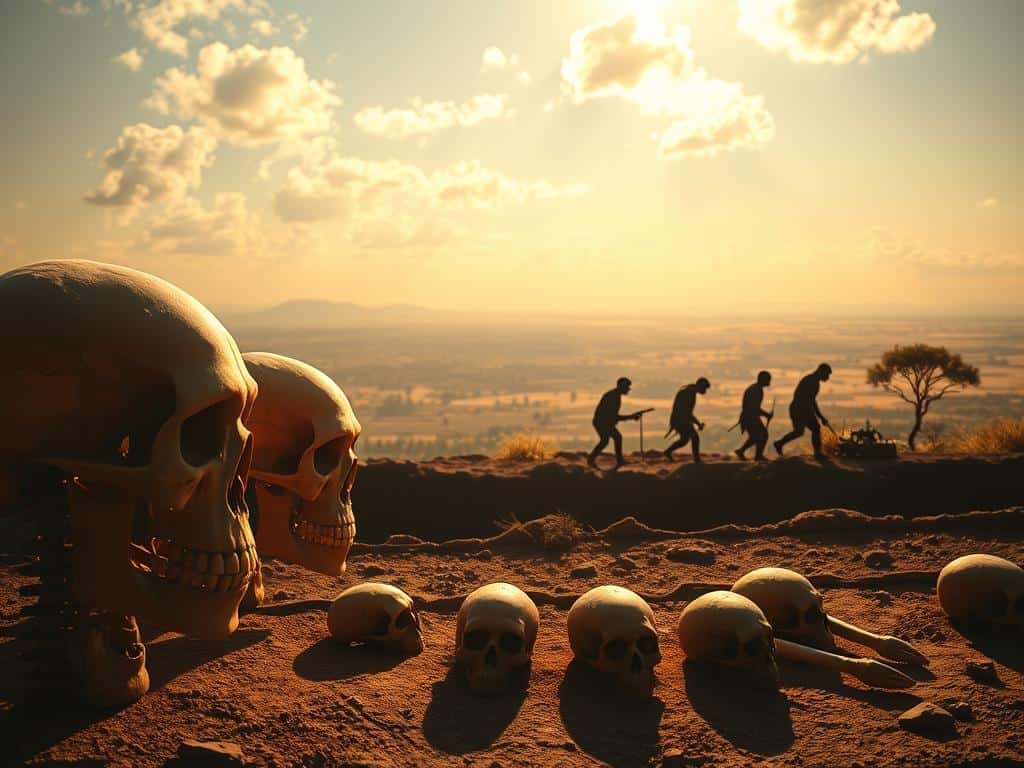
Did you know that our brain size has shrunk by about 100-150 cubic centimeters in 6,000 years? This shows how much our species has changed. Our brain, social life, and behavior are all linked to our history.
It’s amazing how our brain and behavior have evolved. Our ability to talk, feel empathy, and work together comes from our early days in small groups. These skills helped us survive and thrive.
Our journey also shows how culture has shaped us. We’re different from our primate relatives in many ways. Knowing our past helps us understand our minds and societies today.
Key Takeaways
- Human evolution reveals a decrease in average brain size over the past millennia.
- Small social groups have significantly influenced our emotional and cooperative behaviors.
- Cognitive abilities of modern humans are unique compared to our primate cousins.
- Behavioral changes are tightly interwoven with the cultural practices formed through our evolutionary history.
- Understanding our evolution helps to contextualize the complexities of modern social structures.
Understanding the Basics of Human Evolution
Human evolution is a captivating journey into our past. It shows a complex mix of genetic relationships and adaptations. We share a 99% DNA similarity with chimpanzees, tracing back 4 to 8 million years to our common roots. This helps us see how hominins developed unique traits that set us apart from other great apes.
Our Lineage and Genetic Relationships
Our evolutionary history is filled with diverse human species, showing a rich tapestry of relationships. The idea of a “family bush” helps us understand these connections. Fossils from Africa and Eurasia have given us a timeline of human evolution, spanning six million years.
Important periods like the Miocene and Pleistocene shaped our evolution. They played key roles in our development.
The Role of Brain Enlargement
Brain enlargement is a key feature of human evolution. Our ancestors had small brains, around 300-400 grams. Over time, brain size grew, leading to better thinking and complex behaviors.
The human brain’s unique structure supports advanced skills. This includes language and social understanding. It shows how brain evolution has greatly influenced our species.
The Impact of Human Evolution on Cognition
I find it amazing how human evolution has changed our thinking and actions. From the first humans 1.8 million years ago to today’s complex societies, our brains have evolved a lot. This evolution shows in our language, art, and social skills, marking big changes in how we think.
Behavioral and Cognitive Changes
The rise of social thinking was a key moment in human history. It led to better teamwork and problem-solving. Just like our ape relatives, we have learned to use tools and work together, thanks to our ancestors.
This has helped us build strong social groups. These groups help us work together and pass on knowledge to future generations.
The Neuroanatomical Basis of Thought
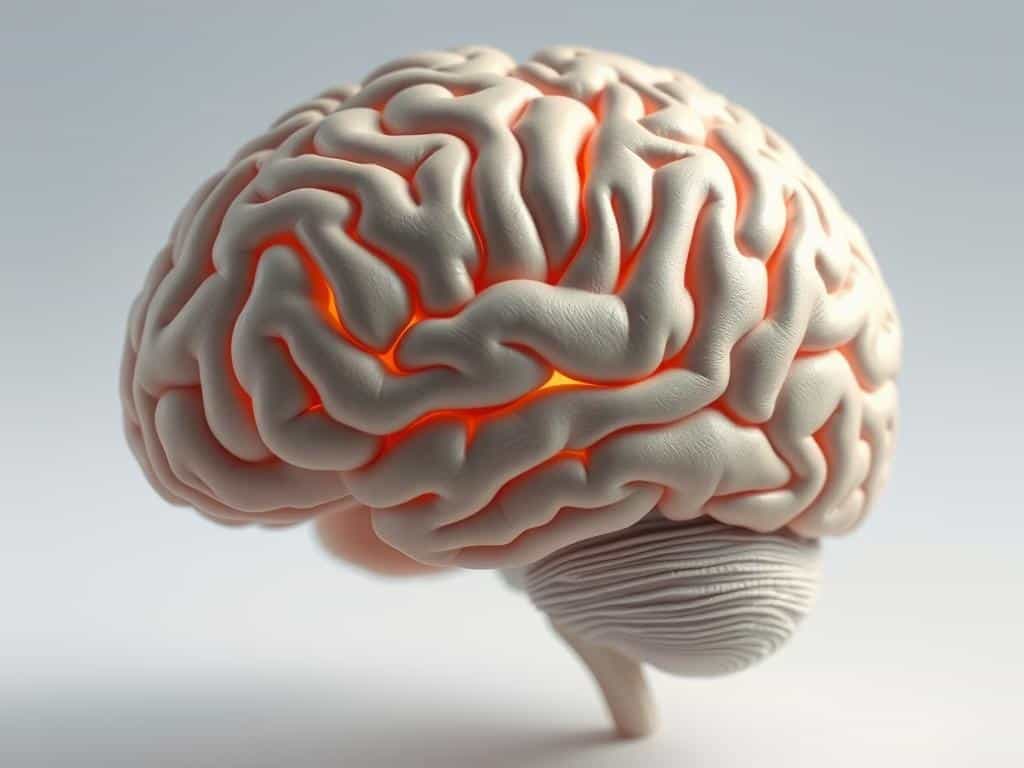
Looking at the human brain shows us special structures. The big growth of the neocortex helps us think and plan better. These changes make our brains more flexible and efficient.
Understanding these brain changes helps us see how our evolution has shaped our thoughts and actions. It shows how our journey has influenced us in many ways.
Human Evolution and Social Structures
Human history shows how evolution and social structures have shaped our interactions. These dynamics reveal how our ancestors survived in small groups. Cooperation and shared identity were key, given the hostile environments they faced.
Small Group Dynamics and Cooperation
Our survival depended on small groups with tight connections and cooperation. These groups helped early humans share resources and knowledge. This cooperation was vital for overcoming environmental challenges, building community, and mutual aid.
Cultural evolution sparked progress, leading to innovations that boosted survival rates. This progress was a result of their cooperative efforts.
Fear of the Unknown and Strangers
The fear of strangers has evolutionary roots, shaping social structures to protect group members. This fear helped early humans avoid threats. Today, it can limit our social connections beyond our immediate communities.
Our ability to empathize allows for broader social connections. Yet, our instincts often clash with this. The challenge is to build social cohesion among diverse populations.
Conclusion
Looking back at human evolution, it’s clear how our past shapes us today. Our connection to primates, dating back millions of years, shows the growth of our minds. Fossils tell us about the changes in our bodies and how our ancestors lived together.
Thanks to anthropology and biology, we know more about our history. We’ve found early human footprints and learned about our mix with Neanderthals. This knowledge helps us face today’s problems better.
By seeing our evolution, we can tackle issues like health gaps and social conflicts. Knowing our past helps us understand why we act certain ways. This knowledge is key to building a world where everyone works together, beyond our differences.
