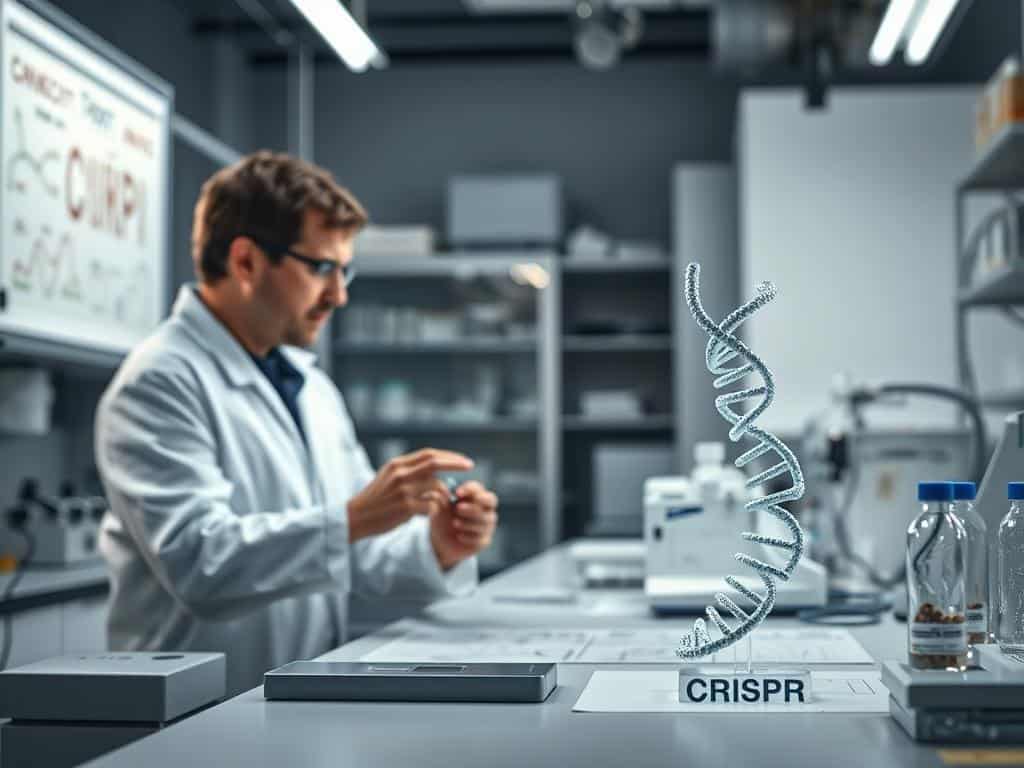
Did you know CRISPR technology has changed the game in just a decade? It has led to thousands of research articles across many fields. This tool lets us edit DNA with precision, making big waves in biotechnology and health.
Jennifer Doudna and Emmanuelle Charpentier won the Nobel Prize in Chemistry in 2020. This shows how important CRISPR is in science.
CRISPR comes from a microbial immune system. It lets researchers fix genes linked to diseases thought to be untreatable. It’s not just for medicine; it’s also changing agriculture and conservation.
I find it amazing how CRISPR is changing our view of biology. It’s opening doors to new treatments we never thought possible.
Exploring CRISPR shows it’s not just changing health and genetics. It also brings up big ethical questions. As we move forward, we need to think about these issues carefully.
Key Takeaways
- CRISPR technology has been instrumental in advancing gene editing over the past decade.
- It offers a high level of precision and efficiency compared to traditional gene-editing methods.
- The Nobel Prize awarded in 2020 highlights its importance in both research and applications.
- Potential therapeutic uses aim to address genetic diseases once deemed untreatable.
- CRISPR is being explored for varied applications, from agriculture to restoring extinct species.
- Public engagement and ethical considerations are critical in the CRISPR discussion.
Understanding the Fundamentals of CRISPR
Learning about CRISPR helps us see its big role in genetics and biotech. It was first found in bacteria as a way to fight viruses. Scientists then turned it into a tool for making precise changes to DNA, starting a new chapter in genetic studies.
What is CRISPR?
CRISPR means Clustered Regularly Interspaced Short Palindromic Repeats. It’s a tool that can be used in many ways in biotech. The CRISPR-Cas9 system uses the Cas9 enzyme to cut DNA at specific spots. This makes it easier to fix genetic problems, something old tools couldn’t do well.
How Does CRISPR Work?
CRISPR works by using a guide RNA that matches the DNA. This guide RNA finds its DNA match in the cell. Then, the Cas9 enzyme cuts the DNA. This lets researchers fix or change DNA, which is useful for treatments.
This method is easy to set up and is very affordable. It makes research on diseases faster and cheaper.
Comparing CRISPR with Other Gene-Editing Tools
CRISPR is better than old gene-editing tools in many ways. It’s faster and cheaper to use. This means research on diseases can move forward quicker.
Studies say CRISPR could help treat over 8,000 genetic diseases. This has led to a big increase in research and papers on CRISPR. Scientists like Jennifer Doudna and Emmanuelle Charpentier discovered it in 2012.
Impact of CRISPR in Medicine and Health
CRISPR technology is changing medicine, focusing on gene therapy and disease treatment. It’s helping us tackle genetic disorders in new ways. For instance, the FDA approved CRISPR for sickle cell anemia, marking a major breakthrough.
Studies also show CRISPR’s success in beta-thalassemia. Patients saw big increases in fetal hemoglobin levels after treatment.
CRISPR’s impact goes beyond genetic diseases. It’s being tested in 89 clinical trials for conditions like type 1 diabetes and cancer. Gene-edited T-cells and KRAS inactivation are showing promise in cancer treatments.
CRISPR could also revolutionize how we detect pathogens. This could be a game-changer in public health.
But, we must consider the ethics of CRISPR. Debates on human germline editing raise concerns about altering the human genome. Issues like “designer babies” and biodiversity preservation are critical.
As we explore these health and medicine breakthroughs, we must balance innovation with ethics. This ensures CRISPR’s benefits are maximized while avoiding risks.
