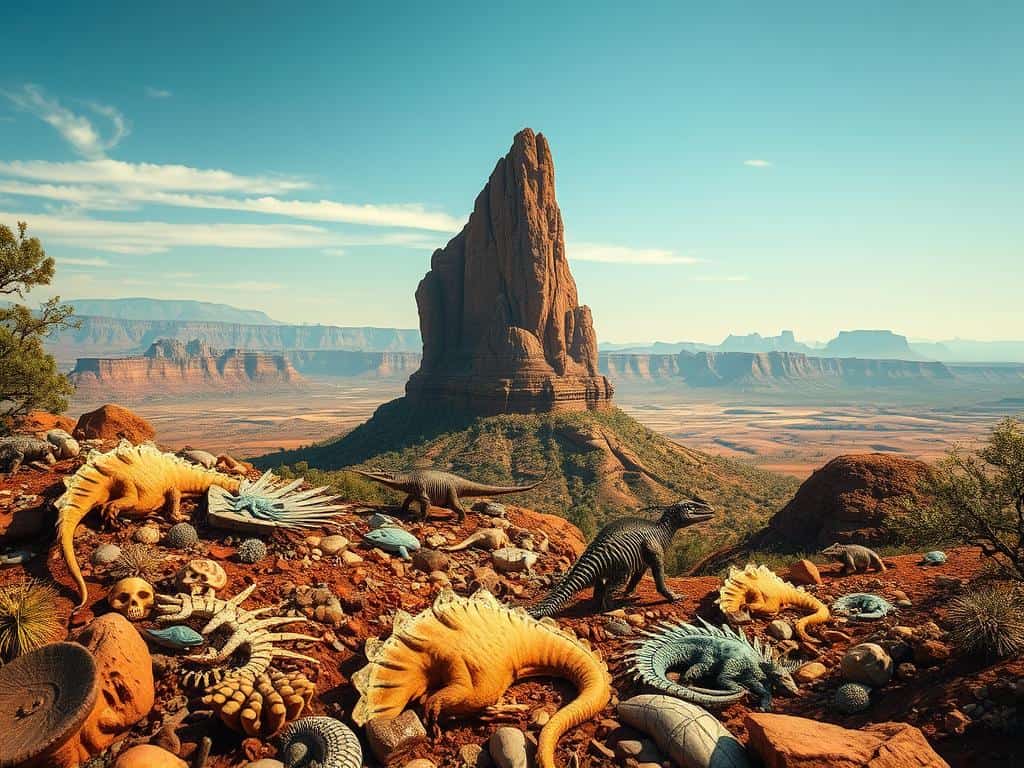
Did you know fossils are as old as 3.48 billion years? They tell us a lot about Earth’s history and how life evolved. Fossils are like ancient remains that show us how life has changed over time.
By studying fossils, we learn about extinct species and how they differ from today’s life. The fossil record helps us see how life on Earth has evolved over millions of years. Thanks to radiometric dating, we can explore the past and see how ancient beings relate to their modern relatives.
Key Takeaways
- Fossils provide critical evidence for the history of life on Earth.
- The fossil record spans billions of years, showing evolution over time.
- Different types of fossils include body fossils, trace fossils, and chemofossils.
- Radiometric dating has changed how we understand fossil ages.
- Evolutionary relationships can be inferred by comparing extinct and modern species.
- The fossil record reveals significant transitions in various life forms.
- Observations of modern species confirm ongoing evolutionary changes.
The Role of Fossils in Understanding Earth’s History
Fossils are like windows into our planet’s past. They show us what ancient life was like and where it lived. By studying how fossils form, we learn more about life long ago. This process, called fossilization, happens when life is quickly buried in sediment.
This protects it from decay. For example, insects trapped in amber can stay perfectly preserved for millions of years. This lets scientists study them long after they lived. It’s not just about the individual organisms but also the ecosystems they were part of.
What are Fossils and How are They Formed?
Fossils are remains of life that lived over 10,000 years ago. They can form in many ways, like through petrification. This is when minerals replace the original material, turning it into stone.
Other fossils, like footprints or burrows, tell us about the behavior of ancient life. Knowing about different fossils helps us understand Earth’s history. It shows us the vast time spans involved.
Types of Fossils and Their Importance
Fossils come in many forms, like body fossils and trace fossils. Each type is important for understanding life in the past. Body fossils show us what ancient life looked like, while trace fossils tell us about their actions.
For example, the fossil fish Knightia eocaena found at Fossil Butte National Monument helps us learn about ancient oceans. The fossil record shows how life has changed over 3.5 billion years. It helps us understand Earth’s history and how life evolved.
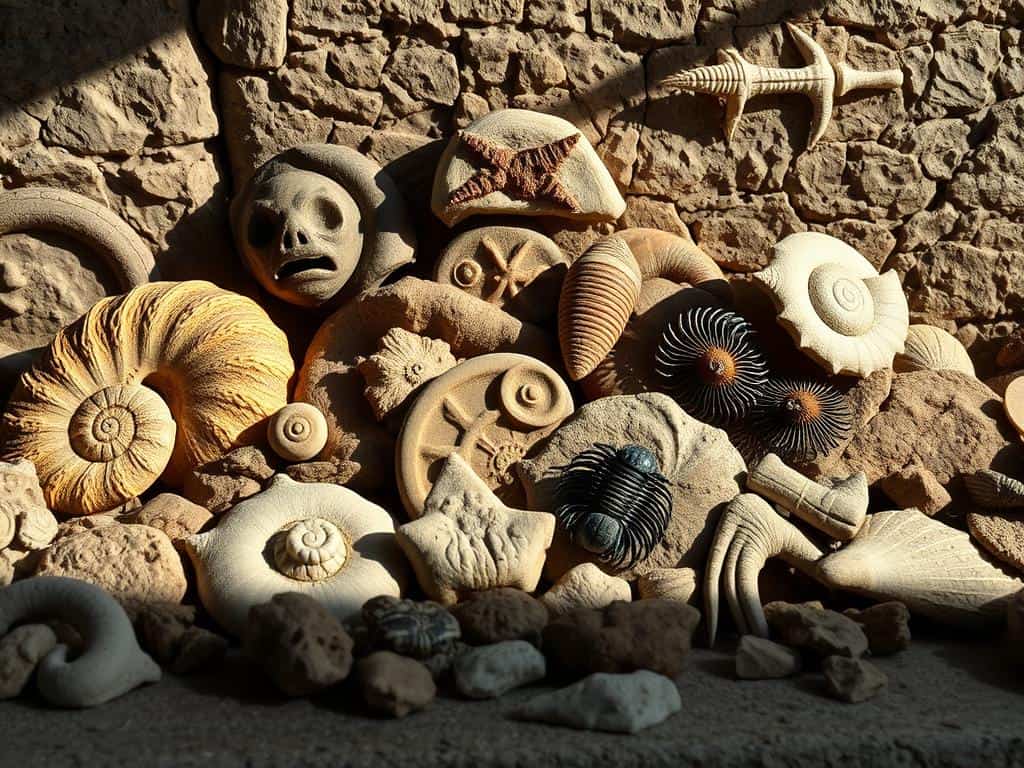
Fossils & Evolution: Evidence of Life’s Transition
Understanding how life has changed over time is key to evolutionary biology. Transitional fossils show these changes. They connect different life forms, revealing how evolution works. For example, finding fossils like Archaeopteryx has made me see how life adapts to its surroundings.
Transitional Fossils and Their Significance
Archaeopteryx is a key transitional fossil. It has bird-like feathers and dinosaur-like teeth. This shows how birds evolved from flying reptiles. It’s about 147 million years old.
Tiktaalik, found in 2006, is another important fossil. It lived around 375 million years ago. It shows how life moved from water to land. Its fins turned into legs, marking a big step in evolution.
Case Studies: Archaeopteryx and Tiktaalik
Archaeopteryx and Tiktaalik have greatly helped us understand evolution. They show how life has faced and overcome challenges over billions of years. These fossils tell us about our planet’s history and the amazing diversity of life.
