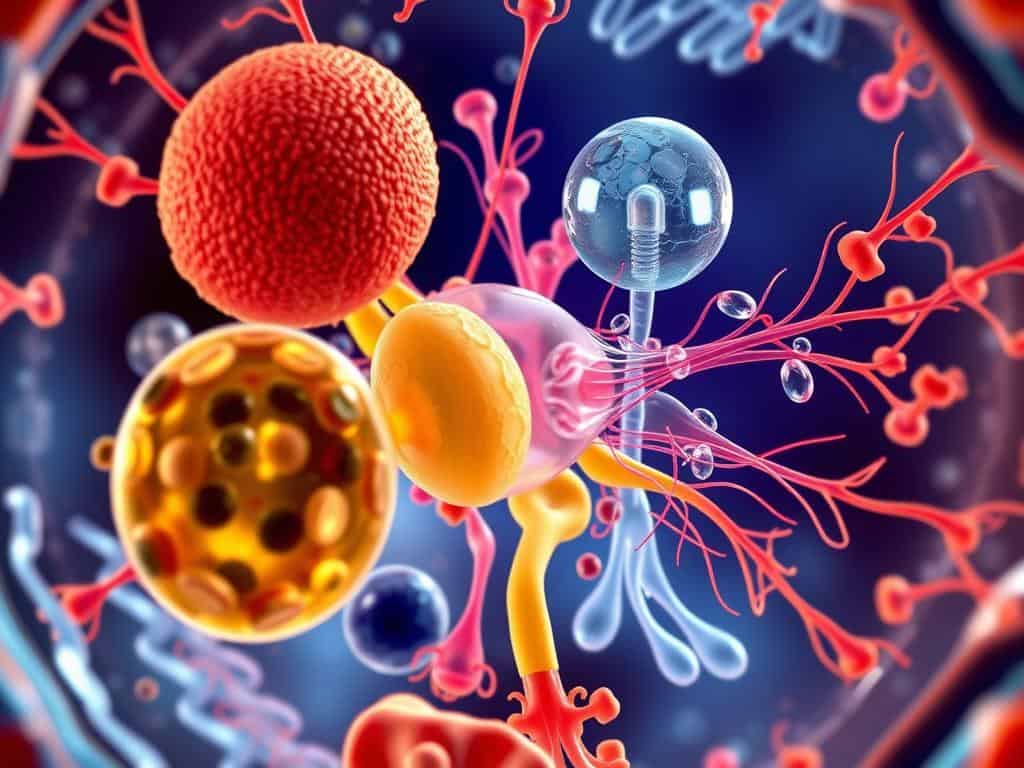
Did you know that each human body has more than 30 trillion cells? This huge number shows how important cell biology is. It helps us understand ourselves and all life on Earth. The study of cells started with Robert Hooke in 1665, and it has grown a lot.
We will look into how these tiny units make up everything from simple to complex life forms. By the early 1800s, scientists had a basic idea of cell theory. It says all life is made of cells, and all life functions happen in these cells. This idea connects all living things and shows how big biology is.
New tools like the electron microscope, which came out in the 1950s, let us see more into cells. Knowing how cells work, from the outer layer to the inner parts, is key to understanding this field.
Key Takeaways
- Cell biology is key to understanding life.
- All life is made of cells, as cell theory says.
- New tools have changed how we see cells.
- Each human body has about 30 trillion cells.
- Cells have common parts, like the outer layer and DNA.
- Learning about cells helps in medical and biological research.
Introduction to Cell Biology
Exploring cell biology opens a world of complexity, focusing on the cell, life’s basic unit. It delves into cells’ organization, structures, and how they work. The field is key because it shows all living things are made of cells.
Defining Cell Biology
Cell biology is a foundation for many sciences, studying cells and their interactions. It helps us understand life’s processes, like energy use and growth. Each discovery, from cell talk to protein analysis, deepens our grasp of life.
History of Cell Biology
The study of cells began in the 17th century with Robert Hooke, who named the cell. Antonie van Leeuwenhoek later found living cells. The 19th century saw big leaps in microscopy, leading to cell theory by Matthias Schleiden and Theodor Schwann. This theory shows all life comes from cells and new ones grow from old ones.
Key Concepts in Cell Biology
Exploring cell biology, I see the importance of key principles. The cell theory is a major one. It helps us understand living things. Also, knowing the different types of cells gives us a deeper look into their world.
Understanding the Cell Theory
The cell theory was born in the 1830s. It says all living things are made of cells. This shows cells are the basic units of life.
It also proved that cells are essential for life’s processes. This idea changed how we see life and its beginnings.
Types of Cells
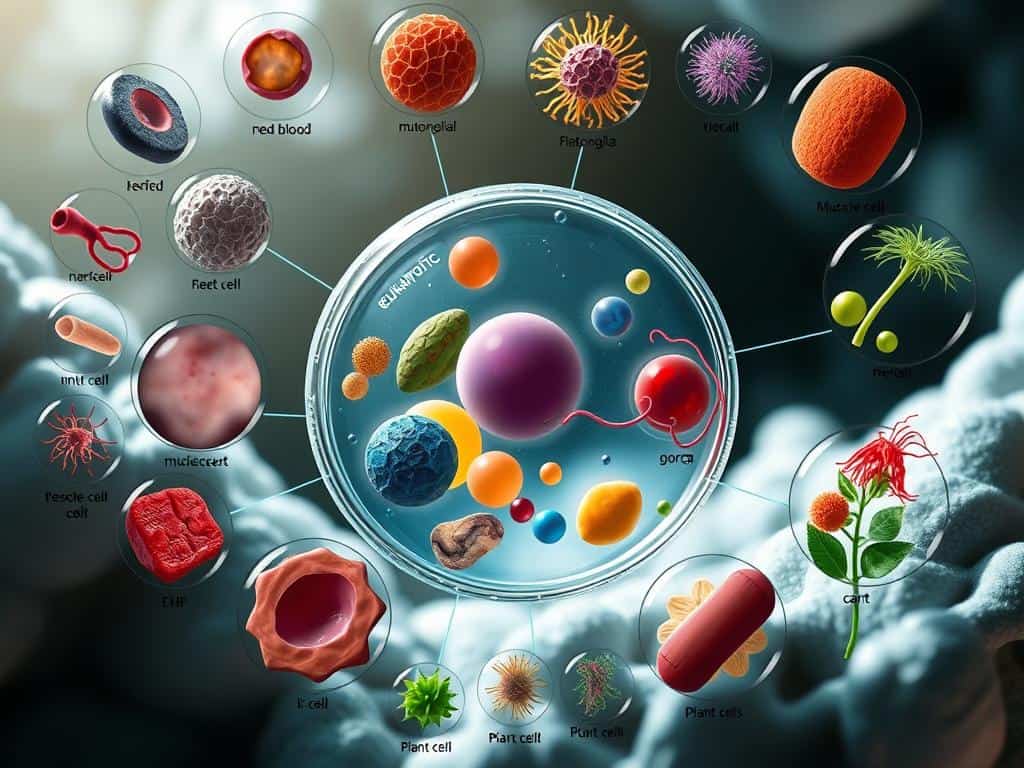
Cells are grouped into two main types: prokaryotic and eukaryotic. Prokaryotic cells, like bacteria, don’t have a nucleus or organelles. On the other hand, eukaryotic cells have a nucleus and organelles.
This difference helps us understand how cells work and change in different life forms.
Functions and Structures of Cells
Cells are the basic building blocks of life. They don’t just sit there; they work hard to keep things balanced, grow, and carry out many tasks. The cell membrane, made of two layers of phospholipid molecules, controls what goes in and out. This is key for the cell’s exchange with its environment.
Cell Characteristics
Cells vary greatly in size, from tiny to quite large. This shows how different life forms have cells that fit their needs. For instance, prokaryotic cells are small, while eukaryotic cells are bigger. Inside these cells, the nucleus holds DNA, which is vital for passing on traits and information.
Organelles and Their Roles
Organelles are like tiny organs within cells. They each have a special job to keep the cell healthy and working well. Mitochondria, for example, make ATP, the cell’s energy source. Ribosomes make proteins, and lysosomes break down waste. The endoplasmic reticulum helps with metabolism and making lipids and steroids.
By understanding organelles, we can see how cells keep life going. This is why knowing about organelles is so important.
Key Techniques in Cell Biology
Cell biology uses advanced techniques to study cells. Microscopy advancements help us see cells in great detail. Molecular biology techniques also play a big role in studying genes and their role in diseases and growth. These methods are key for deep cell research.
Advancements in Microscopy
New microscopy advancements have changed how we study cells. Light microscopes can show objects up to 1,000 times larger, with a resolution of about 0.2 μm. Fluorescence microscopy lets us see specific proteins in cells, using green fluorescent protein (GFP).
Confocal microscopy creates sharp images by focusing on specific depths. This helps make three-dimensional pictures from two-dimensional scans. Two-photon excitation microscopy is gentle on cells, perfect for live studies.
Molecular Biology Techniques
Molecular biology techniques have changed DNA and RNA studies. Polymerase Chain Reaction (PCR) makes more of specific DNA sequences. Gel electrophoresis separates DNA fragments by size.
Methods like Enzyme Linked Immunosorbent Assay (ELISA) and radioactive tracers help measure substances in cells. These molecular biology techniques give us deep insights into genetics and cell functions. They’ve greatly improved our understanding of cell biology.
Conclusion
Cell biology shows us how complex and fascinating the basic units of life are. Every living thing is made up of cells, each with its own role. For example, the human body has about 37.2 trillion cells working together to keep us healthy.
This study also highlights the variety of cellular structures and how they work together. It shows us the foundation of life as we understand it.
Important parts of cells, like mitochondria and lysosomes, play key roles. Mitochondria make most of the cell’s energy, and lysosomes break down waste. Ribosomes, too, are vital for making proteins, showing how a single cell can be very active.
Studying these parts helps us understand how cells work. This knowledge leads to new discoveries in medicine and biotechnology.
As we learn more about cells, we make big strides in science. This research has helped create over 200 vaccines. It also helps us understand diseases like cancer, which affects about 1 in 3 people.
This article shows that studying cell biology is more than just learning. It’s essential for improving human health and expanding our knowledge.
