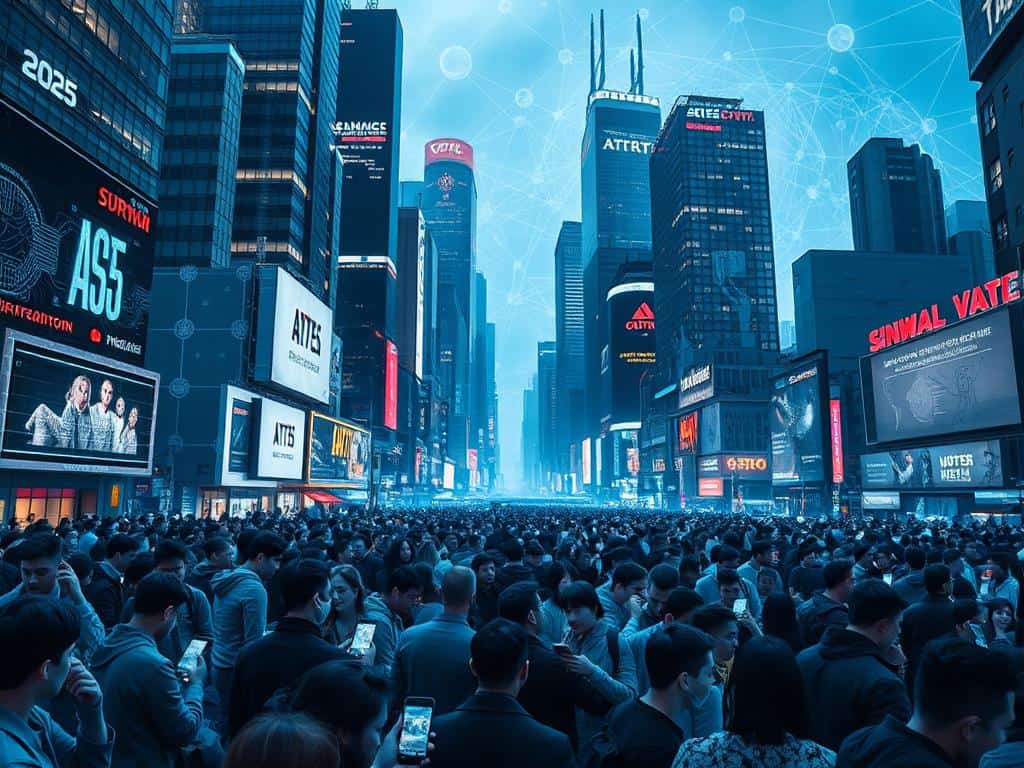
Did you know that by 2025, the total amount of data created globally is expected to swell to an astonishing 163 zettabytes, roughly ten times more than in 2017? This figure shows how important the Age of Information is. It’s a time of fast tech growth and endless data.
Looking at society in 2025, we see a big change. The tech impact is not just about new tools. It’s changing how we connect, work, and live together.
The COVID-19 pandemic made us rely more on digital tools. A study by Pew and Elon University’s Imagining the Internet Center found over 915 experts agree. They say we’ll use digital tools more for work, learning, and health.
While many are excited about these changes, there are big worries too. Issues like economic inequality, fake news, and privacy concerns are growing. We need to think deeply about how technology affects our lives and society.
Key Takeaways
- The Age of Information will see data creation explode, reaching 163 zettabytes by 2025.
- COVID-19 has accelerated our reliance on digital tools across multiple sectors.
- Experts anticipate a deeper integration of technology into our daily lives.
- Challenges such as misinformation and economic disparities are significant concerns.
- Understanding the impact of the tech industry is key for facing future societal challenges.
The Age of Information: Transformations in Communication
The way we communicate has changed a lot in the Age of Information. This change is mainly because of digital communication. Now, we use digital tools more, leading to more remote work and online chats.
This shift changes how we work and interact with each other. It makes us more connected but also shows some problems.
Increased Reliance on Digital Tools
Personal computers started changing things in the late 20th century. At first, only a few homes had them. But by 2000, more and more people had computers.
Now, we use emails, messaging apps, and social media to talk to each other fast. This has changed how we connect.
Growth of Remote Interactions
The pandemic made remote work even more common. It was hard for some but also freed others. More people are using telemedicine, online classes, and virtual meetings.
This shows how technology can open up new chances. But it also affects how we relate to each other.
Impact on Social Dynamics
Digital communication has changed social interactions in many ways. It helps us connect with people all over the world. But it can also make some feel lonely.
There’s a mix of good and bad in this change. Not everyone has the same access to technology. This shows problems in our society. But, adapting to technology will shape our future interactions.
Challenges and Inequalities in the Age of Information
The Age of Information brings big challenges, like economic inequality. Despite tech advances, many people are left behind. About 21 million Americans don’t have fast internet at home, as defined by the FCC.
This shows a big gap in access and opportunity. It points out how economic status affects digital connection.
Widening Economic Inequality
Economic inequality is a big problem in the U.S. Digital access makes it worse. While 81.4% of Americans have broadband, the poor are left behind.
Only 21% of low-income households have fast internet. In contrast, 80% of the wealthy do. This means fewer job and education chances for many.
Rise of Misinformation
Technology has made spreading false information easy. This has hurt public trust. It’s hard to know what’s true online.
We need to learn to spot fake news. This is key in a world where lies spread fast.
Privacy Concerns and Data Security
Our digital lives raise big privacy and security worries. Every online action increases the risk of data breaches. Without strong protection, our privacy is at risk.
Our data is valuable. Keeping it safe is essential for our privacy and dignity.
Conclusion
The Age of Information is changing our world in big ways. It’s bringing new communication and digital interactions. But, it also brings big challenges like fake news, privacy worries, and unfair economic gaps.
We need to work on making the digital world fair for everyone. This means using technology wisely and making sure everyone has a chance to use it. We should focus on creating a world where technology helps everyone, not just a few.
Our future depends on how we use technology. We must act together and make sure technology is used for good. Let’s work towards a world where everyone can thrive online, with understanding and fairness for all.
